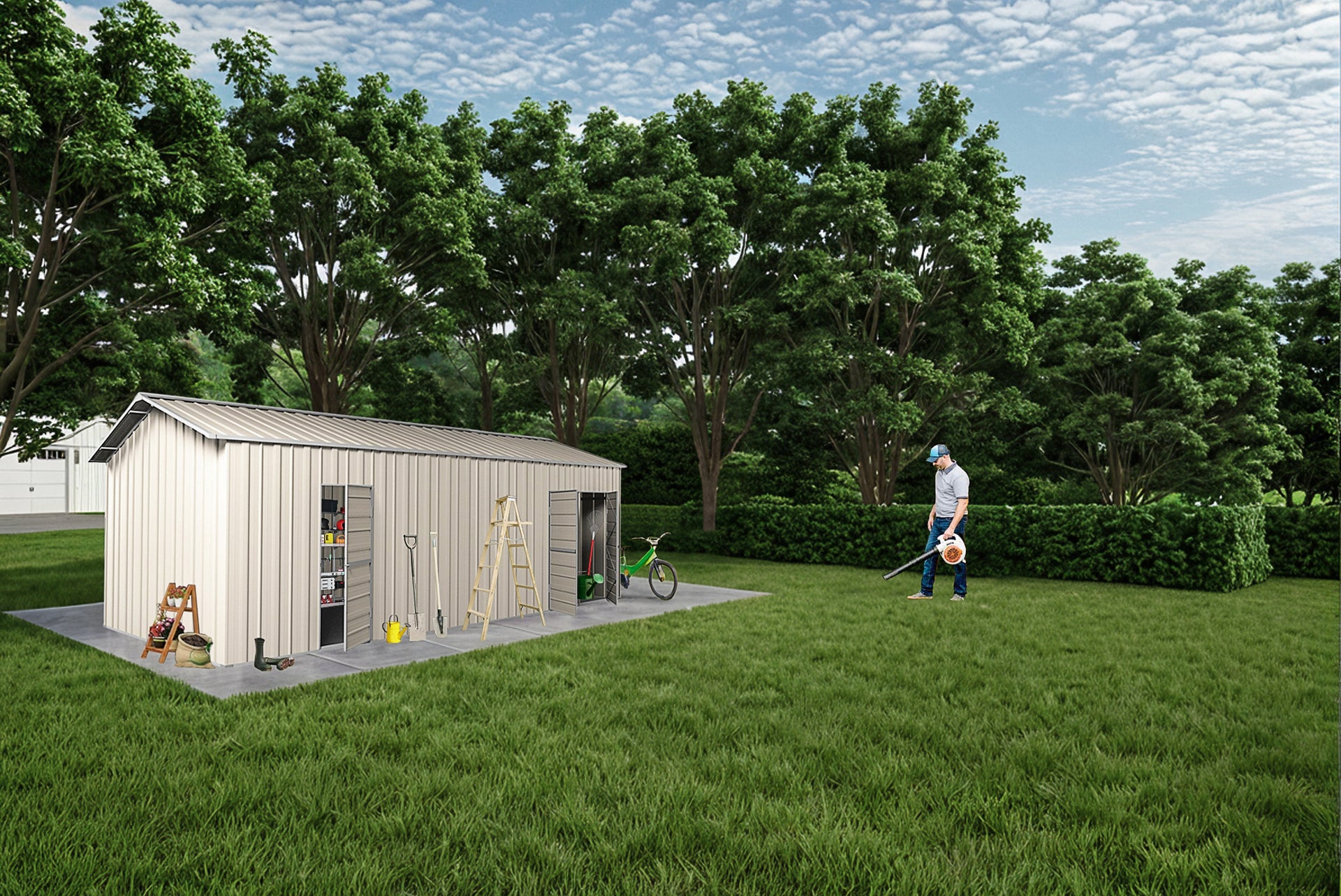
A garden shed commonly defaults to the eyesore of the garden. Your beautiful landscaped, trimmed, mowed, flower-strewn sanctuary interrupted by the presence of this colossal corrugated steel edifice just plopped down in the least-obvious corner possible. Sure, it's a part of your garden, but it sticks out like a sore thumb. While the rest of the garden might look like some beautiful, verdant landscape, a garden shed can often look like a carelessly misplaced skyscraper against your natural wonderland.
So, to keep the visual harmony of your garden in…well, harmony, today we're looking at several creative ways you can help your garden shed blend into the wondrous sanctuary you've painstakingly built for yourself.

Colour
The most basic form of blending comes from colour. Most sheds come in either black, white, or green. Sometimes you'll find other colours, and sometimes they'll be advantageous to blending in amongst your garden. Sometimes, cost and size restrictions means you'll have to settle for the garden shed that is less than flattering.
Fortunately, getting your garden shed's colouring to match that of your garden requires only a rudimentary amount of colour theory, and even then, if you're willing to spend a little more time and money on it, it may not even matter in the first place!
Colour Theory Approach
The simplest and most efficient way to ensure that your garden shed colours are going to help it blend into your landscape is to utilise colour theory, the science of how colours "work".
Using colour theory to get your shed to blend into your garden is a simple matter. Examine the colours that surround the area you want your shed to be, then try to get a shed in the same or similar hues. This ensures a minimum of contrast that will make your shed stand out against the surrounding garden.
The second thing to examine is the quality of light in the place you want your shed. The idea is to try to match the brightness of the hue with the brightness of the light as much as possible. If the shed is going to be in an area that sees frequent sunlight, you'll be able to get away with lighter pastel tones. If it's in a shadier area, try to get darker, more earthy tones.
Customisation Approach
The second option for choosing the colour of your shed is to simply hang all that colour theory nonsense and just, paint it yourself. While it will take a bit more work, not only does this allow you to save time and effort in finding a shed where the stock colour blends into your garden, but in and of itself can be a creative and fun side project!
For best results, you'll want a colour palette of where your shed is going to be placed. This is easy enough to achieve, simply take a picture of the area, then upload it to an online tool that makes a colour palette from an image.Once you have your palette, select your colours, then purchase the necessary paint and a primer suited to the material that your shed is made from.
Apply an even layer of the primer to your shed, then when it's dry, paint your shed in your chosen colours until the desired result is achieved!

Shed Screening Ideas
If you're pretty handy with garden design, the answer to all your problems could be found in garden screens!
These handy panels can be found in almost any aesthetic to match any kind of garden, and people typically use them to cordon off specific areas of a garden for certain uses, like garden barbecues, fire pit gatherings, outdoor relaxation, or - to hide a garden shed!
There are all manner of screens that can suit all manner of gardens. Some are made to look natural so they blend in with gardens that feature dense vegetation and plant life. Others have a bit more of an industrial or constructed aesthetic, and fit more modern gardens with a heavily controlled aesthetic. Simply use your screens to create an alcove in a suitable space (be sure to measure, then measure again, then plot out the area, and measure again before installing your screens!) then build your shed in this alcove.
This can be especially attractive if your shed is being used to separate home life from work life, the screening providing an additional barrier from home and work.

Landscaping Around Shed
If you want to hide your garden shed, and have a green thumb and nouse for garden design, it could be that your love for growing beautiful plants and flowers could be the answer for camouflaging your garden shed from the outset.
If, rather than building your shed around your garden or vice-versa, you can make your shed an aesthetic contribution to your garden, rather than a detractor. For this, a shed made of wood might be a better option, after all natural materials fit in with nature better. However, with the right colours and styling, a metal shed can be just as much a part of your garden.
If you plan your garden design with your shed in mind, it can become a valuable installation in your natural paradise. Constructing gravel pathways or borders around it, framed by bushes and shrubs, or using plants with long foliage to surround the shed can soften its appearance in your garden, and add an element of depth to your yard.
Additionally, rather than making the colour of the shed fit the garden, if you take your shed into account while plotting out your garden, you can plant flowers and other flora around it that will help it blend naturally to its surroundings.
All this before even considering plants that creep! Plants that grow on vines, or that can be trained can be a wonderful addition to your shed. Things like tomatoes, grapes, vines, or trees can be trained to grow along your shed, making it not only beautiful, but a practical addition to your green wonderland.
Though be aware, this may offer certain critters an easier means of egress into your shed during certain months.
If you want a shed, but don't want it to stand out like a sore thumb, your green thumb could be all you need to make an obstruction a feature. If you're not sure which shed might be best for this purpose, the experts at Space Sheds are more than able to assist. Simply contact us here, or call us on 1800 960 901